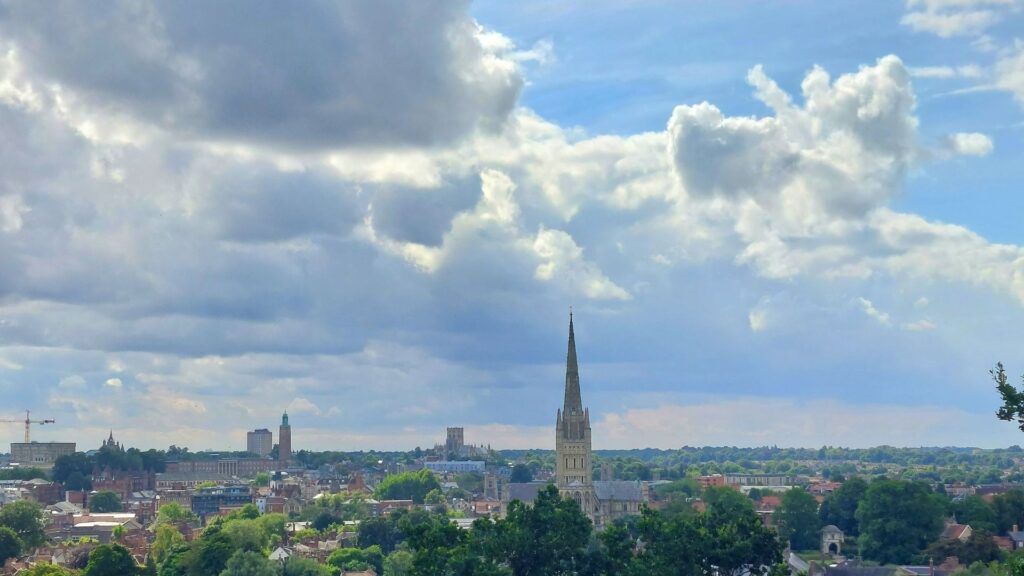
Welcome and thank you for visiting our “fine city” as we like to call it! As a history lover you’ll be pleased to know that there is an absolute plethora of historical gems and interesting museums and tours to encounter. But that’s the problem. What do you pick? There are so many to choose from! Well thankfully we have put together a little guide to help you pick the things most exciting to you! This isn’t an itinerary, you should have the freedom to choose! But we have taken some categories with some options for you to choose from and hopefully it will help you craft your perfect, history-filled stay!
Dining With History
Let’s be honest, one of the most important things to establish first and foremost is where you’re going to be eating. There is a wide range of restaurants and cafes to choose from, but you’re looking for something that carries an element of history, below you’ll find a range of places that we have cherry-picked that should carry the perfect mix! Although there are plenty more out there that I’m sure you will come across during your exploration!
Norwich Market
Open Monday to Saturday, and standing as one of the oldest, continually running markets in the country, Norwich Market was established by the Normans in 1067 during their occupation of the Saxon and Danish settlements that would later become Norwich. Seeing the nearby Saxon market in Tombland as too small, and too Saxon, they created their own in the shadow of the castle for their French merchants to supply the nearby garrison. Over time, as the market grew, it supplanted the Saxon one to become the main market of the city. Ralph De Gauder, a friend of William the Conqueror who would later lead a rebellion against him, had the nearby church built in 1075, although most of what you’re looking at is 15th Century. A tollhouse was also built that was later replaced by the still-standing guildhall when the Crown relinquished control of the market to the city in the 14th century.
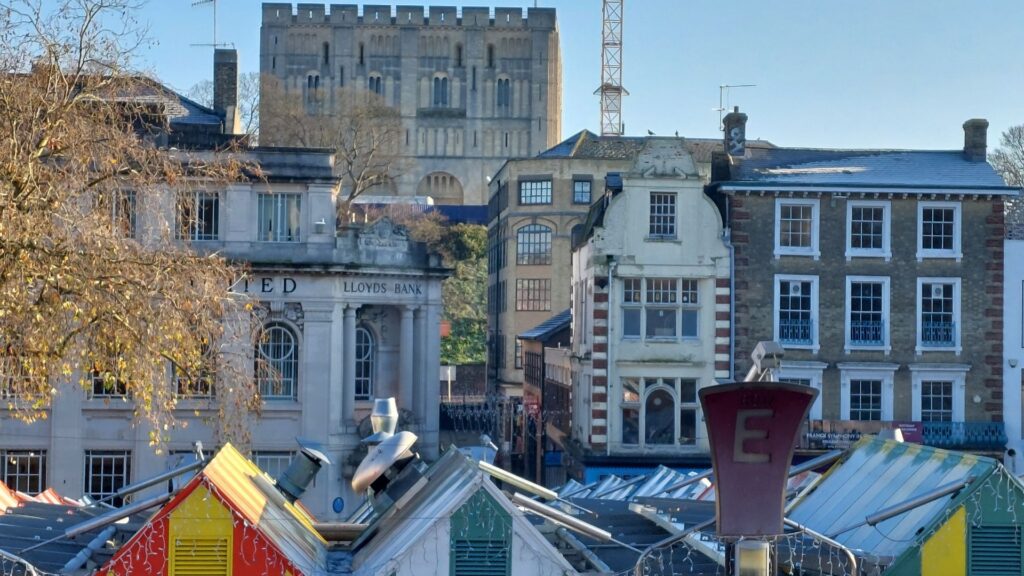
Since then the Market has gone through many changes over the centuries, growing and waning with a changing ring of buildings around it. It’s seen festivals, royal visits, riots and rebellions and a few executions. Today, however, it still holds a variety of different and interesting goods with nearly 200 stalls to choose from! There are a staggering number of stalls offering amazing ingredients to cook your own delicious food or plenty of wonderful options to eat on site or take away. From African cuisine to fish and chips, ice cream to pastries, and with on-site cafe and bar stalls, there is plenty available and many stalls cater to various dietary requirements. There is more than enough to keep you coming back over the course of your stay!
The Belgian Monk
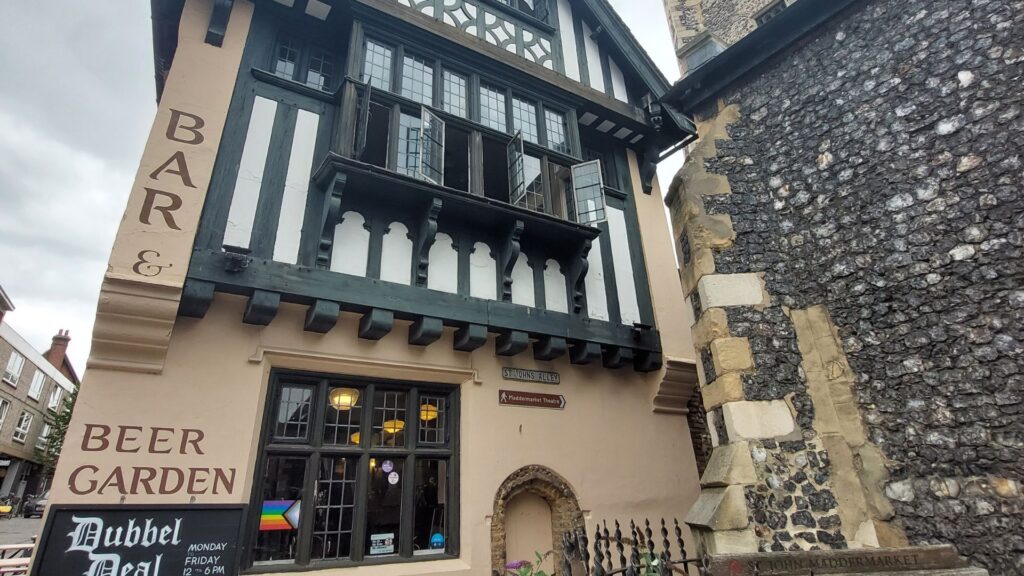
If you’re looking for somewhere indoors but with some real character, The Belgian Monk is a good choice! Based in a faux-tudor building that dates back some 300 years, on the wonderfully historical Pottergate, the themes of this restaurant and pub are ones that are very close to Norwich’s heart; the Flemish, and beer. Over the course of several centuries, Norwich became home to many Huguenots and Walloons. These were protestant people escaping persecution under Catholic rulers and the Spanish Inquisition who fled to England after being invited by the Royal family to help boost the weaving trade in East Anglia and to make a statement about the new Church of England under King Henry VIII. They brought over with them many elements of their own culture including food and beer making.
Beer was traditionally brewed by monks and members of the clergy in their monasteries and came in a number of varieties. Norwich became quite famous for its wide range of beers and would supply other parts of the country.
Today The Belgian Monk combines these things to provide traditionally brewed ales and beers and a fine array of wonderful Flemish inspired meals. As well as this, the architecture of the building itself, and the original courtyard out the back, help to add a real historical atmosphere and just next door is the beautiful church and alleyway of the Maddermarket, the original site where the many weavers would pick up their red madder dye to colour their cloth.
Grosvenor Fish Bar
A very short distance from The Belgian Monk above, at the bottom of Lower Goat Lane, sits Grosvenor Fish Bar. Whether you’re local or from some far flung land, you can’t deny the love for fish and chips in this country, and combined with an award-winning restaurant on a historical site, this is a must-visit place for many people that come to the city. Located in an early 19th century building, the real hidden gem in this spot is the seating area below the restaurant that was built into a 15th century undercroft (a cellar or cool storage for those who are unaware!). Accessible down a flight of stairs from the main restaurant area, most of the original brickwork is admittedly covered by wood panelling. However the original pointed vault ceiling is still very evident and brings the space a grotto-like atmosphere.
The food itself has a wonderful variety as well. A choice of sea bass, mackerel, tuna, herring and squid can be found served as burgers, wraps, sandwiches and, more traditionally, with a side of chips. The business has been running for over 95 years now, so they must be doing something right! And with its location within the borders of Norwich Lanes (a fantastic sprawling network of shops and businesses nestled within historic narrow streets), it is a perfect spot to take a break from exploring before getting right back into historic sight-seeing!
Maids Head Hotel
If you’re looking for a more refined dining experience, then the WinePress Restaurant located in the incredibly historic Maids Head Hotel might be the place for you! The hotel itself is a beautifully restored and ancient building. Built on the site of Herbert De Losinga, the first Bishop of Norwich’s original 1090 palace, most of the current building dates back to the 15th Century (the location of the restaurant and dining courtyard itself) but is layered with many additions from its centuries of use in hospitality. The bar has been serving people since 1287 and the presence of a Norman pillar shows it goes back further. The courtyard that you can dine in was used to house coaches in the 18th century and hasn’t changed much since (although coverings and heating mean you can enjoy it regardless of the weather or season!). With so much history, the Maids Head is one of a select few hotels that claim to be the oldest in the country. Past guests include Edward The Black Prince and Catherine of Aragon, with rumours of Queen Elizabeth I staying in 1578 (although it’s actually more likely she stayed in the nearby Bishop’s Palace in the Cathedral grounds. Many of her royal procession probably stayed here however!).
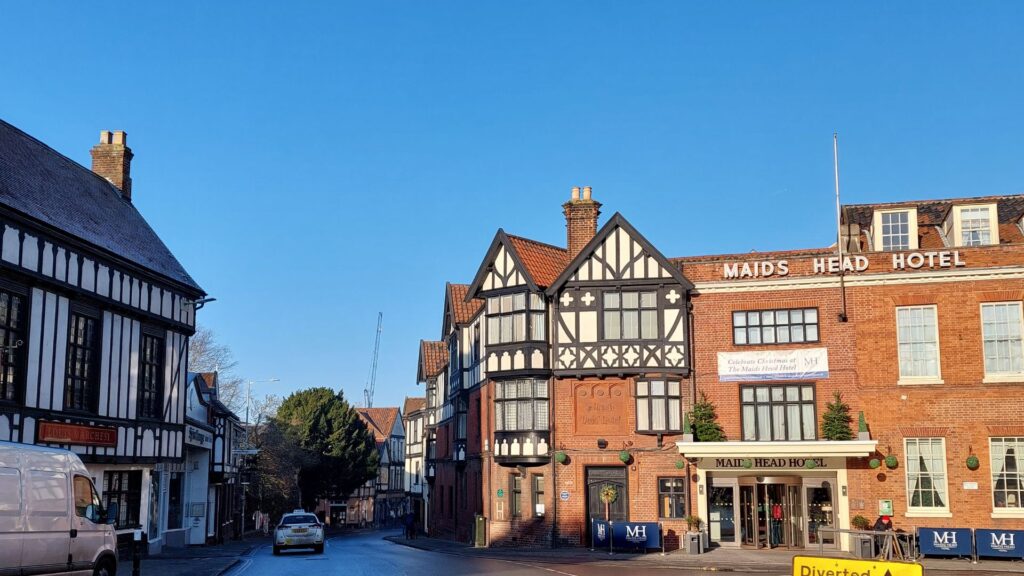
The restaurant is a 2 AA Rosette winning establishment and offers a fine dining menu or a chef’s 6 course tasting menu with accompanying wine flight. You can sit in the original courtyard or the dining room and bookings can be made over the phone or online. There are several menus available throughout the day.
Historical Sights and Sites
Now to the main course of your visit! If what you’re looking for is history, then there is plenty on offer. I can heartily recommend the main places you’ll be recommended to visit by locals, such as the freshly-opened Norwich Castle Museum, The Museum of Norwich and both of its cathedrals but there are also a couple of hidden gems that you might not see on every list of attractions. We’ve picked a couple of places you can find slightly off the beaten path with glorious historical gems hidden within.
Elm Hill
Nearby to the Cathedral in the centre of the city is Elm Hill. A beautifully preserved cobbled street with a number of 16th century Tudor buildings leaning precariously over it. If it wasn’t for some of the modern shops within, and the occasional car bouncing down the cobbled road, you could genuinely believe you’ve stepped back in time, when you turn the corner onto one of the prettiest parts of Norwich. Take care walking along the road surface as it is notoriously easy to trip over but make sure you take in the gorgeous Tudor brickwork, timbers and small courtyards leading off from the buildings. Amongst the charming buildings you will find many antique shops, jewellery, a teddy bear shop and a couple of lovely cafes. One is The Britons Arms which sits at one end with its original thatched roof. The building dates back to the 1340s and is full of character. The other sits in Wright’s Court nearby to the church. The courtyard itself is one of the last surviving residential courtyards that used to be found all over Norwich before being torn down as slums at the beginning of the 20th century.
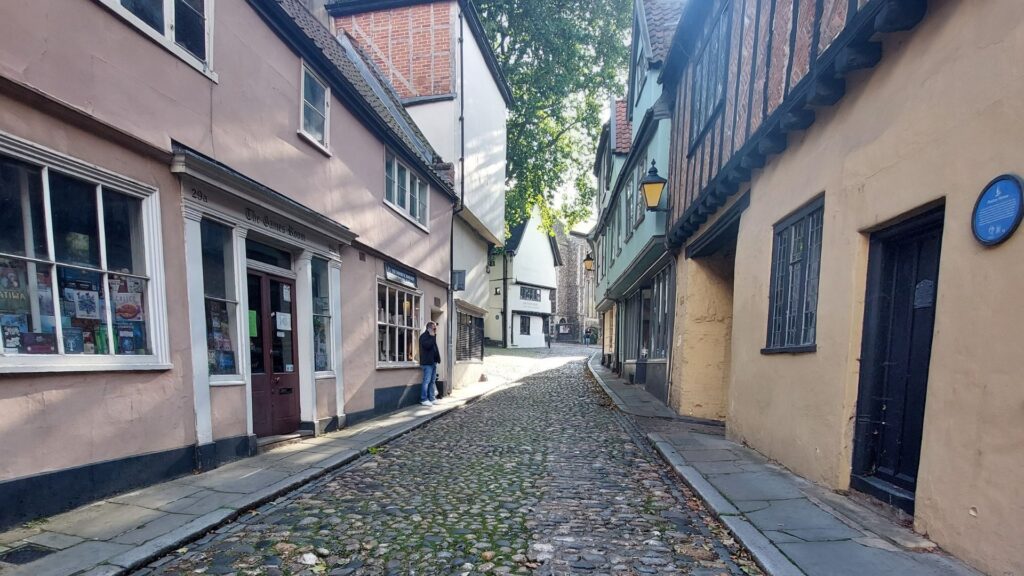
The street itself dates back to the 13th century with some of the original undercrofts being found beneath the buildings. The vast majority of the older buildings on the street, however, date back to the Tudor period as most of the street was sadly lost to the great fires of Norwich in 1508 and had to be extensively rebuilt. The city deemed the area a slum in the 1920s and planned to pull it all down to make way for a leisure centre and swimming pool but thankfully a single councillor fought tooth and nail to preserve it and it now stands as a testament to the city’s heritage. It has been used as a filming location for a number of films including Stardust and Netflix’s Christmas film Jingle Jangle and locals might tell you the tale of Father Ignatius, a controversial figure that tried to bring back monastic lifestyles amongst religious figures and leaned heavily toward catholicism. In the 1860s he tried to establish a monastery on Elm Hill but it was plagued with constant clashes with locals and the Bishop of Norwich before he was chased from the city. Supposedly his ghost can be found on Elm Hill, angrily shouting at passers by and brandishing a black bible.
Cow Tower and the Riverside Walk
If the weather’s nice, and you like some peace and quiet and nature sprinkled in with your history, then a short walk down the rivers edge to Cow Tower might be for you! We recommend starting the walk via the balcony outside the Compleat Angler pub opposite the train station. Walking down a set of steps on the opposite side to the road will bring you onto the main footpath along the river. Walking this way will take you past a number of graceful Willow trees and there’s usually a number of swans that like to frequent this part of the river hoping that you’ll “accidentally” drop some of your lunch their way. The footpath will take you into the grounds of the cathedral alongside the amazing Pull’s Ferry, a 15th Century watergate and ferry house with its impressive flint arch. The footpath leading from the arch to the cathedral was once a canal, used by the Norman construction crews to bring stone up to build the magnificent cathedral itself. It’s named after the ferryman John Pull who, from 1796 to 1841, ran people across the river from the site. On occasion, volunteers from the Girl Guides run a cafe from the 17th century ferryhouse attached to the arch.
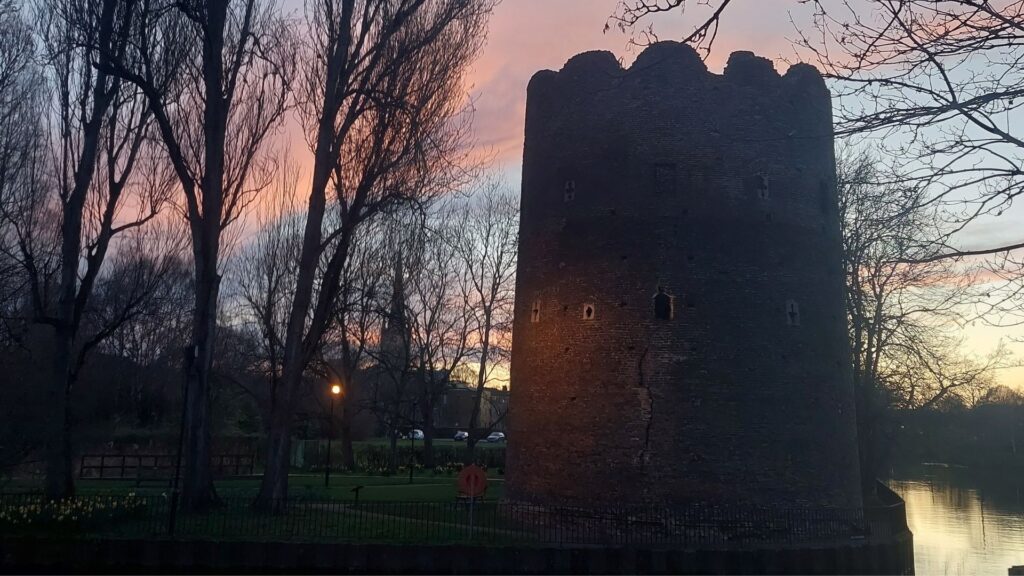
If you continue on your way along the river, as hard as it is to pull yourself away from the cathedral, you will eventually encounter a brick and flint rounded tower, sitting ruined on a bend in the river. This is Cow Tower, named after the patch of land you’re standing on, Cowholme, which was used by medieval workers to graze their cattle. The tower was constructed between 1398-99 and was, at the time, the only standalone gunpowder defence tower in Britain. With a battery of cannons and early firearms, it was a truly dangerous obstruction to any potentially hostile (read: medieval French) ships coming up the river to the city. The top of the tower was destroyed in 1549 during Kett’s Rebellion, an uprising of working people against unfair workers and land rights, which saw the rebels under Robert Kett use cannons to disable the tower. Unfortunately, later Victorian attempts to fix the tower with concrete led to further damage. If you continue further along the river and, once over the bridge, take the left hand fork in the pathway, it will bring you out near The Adam and Eve. A beautifully ancient pub that has been serving beer since the 13th century. It’s the perfect place to end this short walk!
Rosary Cemetery
Another site seldom explored, but worth a mention is the hidden Rosary Cemetery. Located off Rosary Road near the train station, this large cemetery is cut into two separate parts, the old cemetery and the more modern side that is still in use. The old cemetery has been practically left to nature, with its many impressive headstones and standing mausoleum poking out from under plant growth and from between trees. Pathways cut through the foliage like a hidden grid and wildlife such as deer and squirrels are all around. Down each path you’ll discover a whole new host of graves, with many important historical figures buried here such as the Colman family (of Colman’s Mustard) and the Boardmans who were architects responsible for much of the lovely architecture around Norwich including the little chapel near the entrance to the cemetery.
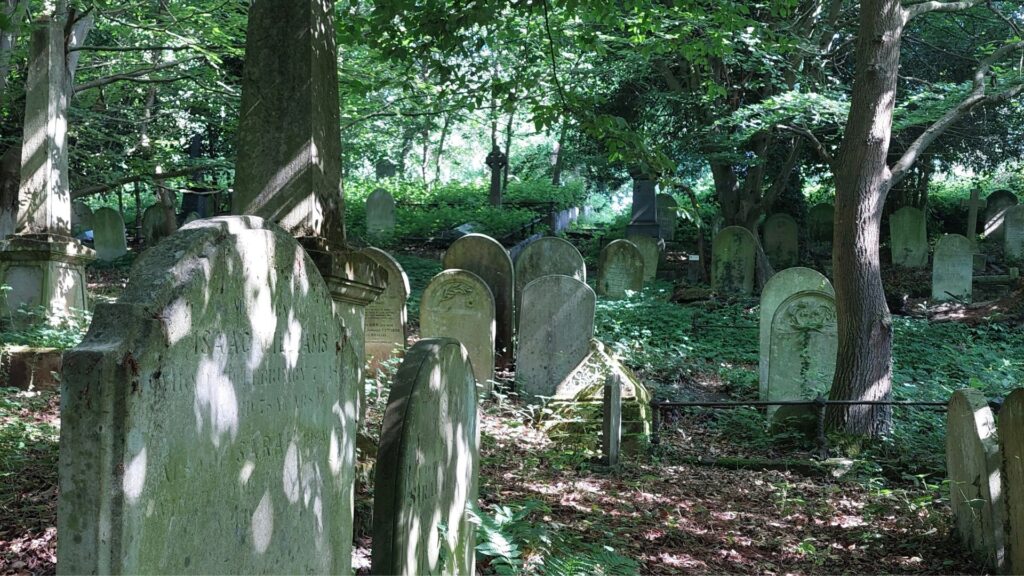
What really makes this place interesting is that Rosary truly stands as one of the very first non-denominational cemeteries in the UK. It was started by Reverend Thomas Drummond, a Presbyterian and Unitarian minister in 1819. Any person of any faith or no faith at all could be buried here, cutting out all of the bureaucracy that came with more traditional branches of Christianity in England and allowing respectful burials to those who would otherwise have no final resting place such as victims of suicide or an unchristened child. The first occupant was his wife who had sadly died before him in childbirth, as was so heartbreakingly common back then, but many big names were buried here since and some of the graves, such as those of the victims of a huge rail accident in 1874 in Thorpe, are a window into some of the lives and incidents that happened in Norwich’s past.
If exploring the cemetery doesn’t satisfy your love for nature, cutting through the modern half of the cemetery will bring you out next to Lions Wood, a gorgeous ancient woodland that cuts through modern Norwich with elderly Oak and Sycamore trees being surrounded by many other species. It’s another great place for wildlife but don’t get lost in the trees!
Norwich Cathedral Close
As mentioned towards the beginning of this section, Norwich Cathedral is often somewhere you will be pointed toward as a place to visit and I fully agree with this recommendation, as one of the largest, oldest and most impressive cathedrals in the country. However, the building itself is one thing, but The Close (or grounds) surrounding it are a different, and worthwhile, destination. As well as the monolithic cathedral, there are a further 80 listed buildings within the grounds that now make up a community of residents, business offices and the school. Alongside these, also occupying the 44 acre site, are the ruins of the monastic infirmary (built in 1175) and around the side of the cathedral building, you will find more ruins that are possibly part of the St Ethelbert’s church that was burned down by Norwich residents during riots in 1272. Nearby to these ruins sits the marble grave of Edith Cavell, one of Norwich’s most famous historical figures who, as a nurse helping soldiers in Belgium during WWI, risked herself by helping allied soldiers escape the clutches of the enemy. Betrayed by a member of the resistance, Edith was captured by the Germans and executed via firing squad in 1915.
The Cathedral grounds came under ownership of the church in 1096 during the Norman occupation. The impressive gates separating the close from Tombland were built in the 15th century and the green that spreads before the cathedral just behind them is a favourite spot for locals to picnic on in summer. Often spoken about as a village that sits in a city, the grounds go all the way down to the river (where the aforementioned Riverside Walk and Cow Tower are located). It’s the perfect spot for a quiet sit down, a nice walk, to take in the history and to see if you can spot the Peregrine Falcons that nest in a box on the cathedral spire!
Hidden Historical Shopping
We have mentioned Norwich Market place at the start as a great place to eat but it’s also an amazing place to pick yourself up some knicknacks. If shopping is your focus, however, there are some great hidden markets and shopping areas amongst the history to find yourself in. Some are tucked in historical buildings, locations or are selling historical items. Below is a selection of some hidden shopping gems in Norwich to visit yourself!
The Lanes
Norwich lanes, a sprawling area of narrow winding streets, alleyways and overhanging buildings, is a wonderfully historic part of Norwich filled with shops, hidden churches, cafes and a museum. In the 14th Century, Norwich, like every other walled city in England, had to abide by a law that forbade the construction of residences outside of the city walls. This led to a quickly diminishing space within the walls and streets ended up narrower as buildings tried to pack into smaller areas. In the 16th Century, the Tudor royal family invited the Huguenots and Walloons to England, Protestant people facing torture and death at the hands of catholic rulers and the Spanish Inquisition. They were locally known as “the strangers” and they settled into the city, bringing with them superior equipment and knowledge to our own weavers. With their influence, Norwich quickly became the second richest city in the UK and most of them settled near the wool merchants. The Lanes would have been part of that and a few of the buildings in the area still sport the wide, shallow, rectangular weavers windows on their upper floors.
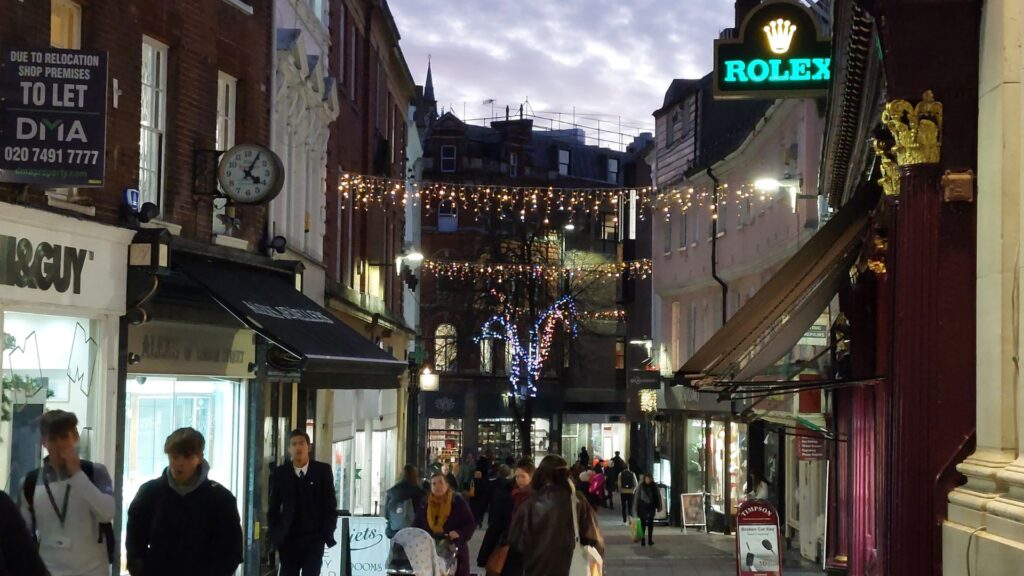
When the walls of the city were brought down in many places at the end of the 18th century and into the 19th century, it meant the city could expand but many of the original, cramped streets remained until WW2. Sadly, caught in multiple night time bombing raids by the Luftwaffe (now dubbed the Baedeker raids), many areas of Norwich with its original medieval streets were burned to the ground or shattered by explosives. This meant that post-war Norwich had to rebuild and, to accommodate the increasing popularity of motor vehicles and the large number of shoe factories in the city, many roads that were once the original winding streets were cleared to make room for large industrial buildings and main roads. Although most of the city ended up being entirely refaced, The Lanes in Norwich survived this period of development to keep its original layout and charm and today acts as a window into what the streets of Norwich once looked like.
Today, the lanes boasts an impressive 300 shops, cafes and boutiques that are perfect for the avid shopper. Anything from jewellery, clothing, food and homegoods can be found here with some quaint cafes and the wonderful Museum of Norwich in the old Bridewell Prison that shows Norwich’s industrial past through the ages! There’s something in The Lanes for everyone!
St Gregory’s Church: Antiques and Collectibles
Just off from The Lanes, on Pottergate and opposite the Grosvenor Fish Bar, sits the old St Gregory’s Church. The church itself dates back to the 1300s but the tower is believed to be older. It used to be one of many of the parish churches that used to be found all around the city, many of which have now been deconsecrated and serve other purposes. They are looked after by the Norwich Historic Churches Trust who ensure the buildings are protected and maintained. The church itself is known for the beautiful medieval paintings uncovered in 1999 during renovations, including a beautiful mural depicting St George and the Dragon that was painted in the very early 16th century and can still be seen on the west end of the north aisle.
The church fell out of use in 1971 and became a community arts centre from 1975 until 2002. From 2007 to 2011 it became an events space and then in 2012 it became the antiques and collectibles market it is today. The market is a fascinating space, with so much crammed into the building that it’s become a labyrinth of interesting historical items. From furniture, to collectibles, Victorian tools to militaria and with the odd bizarre surprise like antique medical equipment and dummies, there is always something fascinating around every corner. With the beautiful medieval church interior all around you, it gives the market an atmosphere akin to something from a fantasy novel. You can easily lose hours of your day exploring the thousands of items hidden around and chatting to the enthusiastic vendors who are happy to discuss the history of each one with you.
Opening hours are 10-5 most days of the week and 11-4 on a Sunday.
Looses Emporium
Looses Emporium is situated on Magdalen Street, possibly one of the most controversial areas of Norwich but also, one of the oldest. The first large settlements appear here around 575CE, built by Anglo Saxons and later, by “Viking” Anglo Danish settlers as well. Most areas settled by the Danes can be found due to the street names on the current landscape. The ones ending in “gate” such as Colegate, Pottergate and Fishergate are the clues as the word “gate” is actually old Germanic or Danish for “street.” Evidence has been found of enormous, defensive ring ditches that once protected the settlements and archaeologists have been very lucky finding lots of clues to the people who once lived here. Collectively, this proto-Norwich was called North Wic Ultra Aquam which roughly translates to “Northern Settlement over the Water.” The ‘Northern Settlement’ (North Wic) part is what is believed to become the name ‘Norwich’ later down the line and the area is still called Norwich Over The Water today! The area was very popular in terms of trade as the main North to South road let through this way and it was next to the river that also helped with industry. After suffering severe damage during WW2, most of Magdalen Street was remodelled but enough survived for you to be able to find the historic gems amongst the modern architecture. Sadly, in recent years, the area has been neglected by the city and some argue it has become a bit of an eye-sore, especially around the now doomed Anglia Square. Debates rage as to what is to become of the old shopping centre and street but there is still plenty to find around here in terms of charity and antique shops, including Looses amongst the dilapidation.
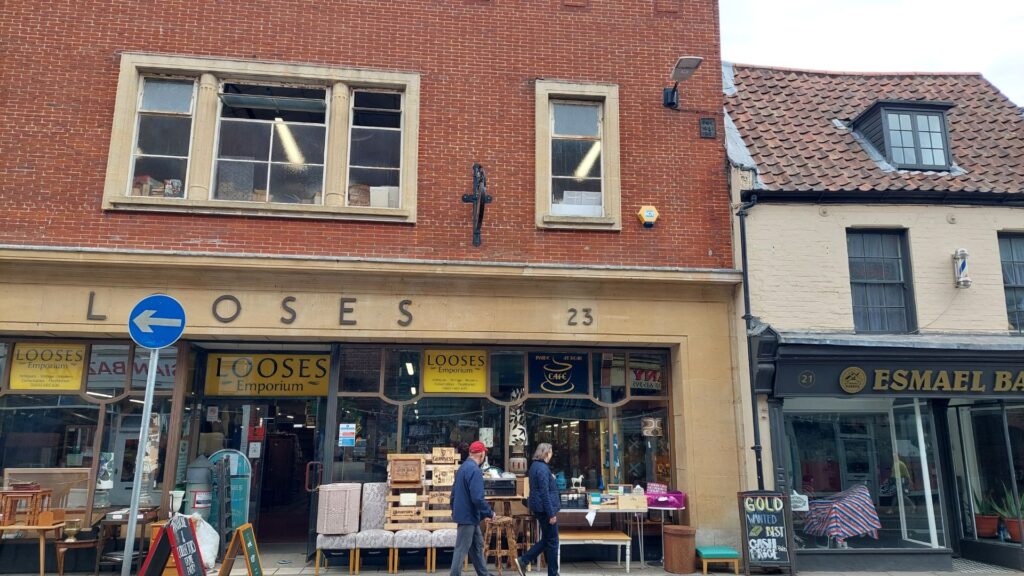
Pre WW2, Looses was “Looses China” a shop for fine cutlery and expensive imported china tea sets and goods. It was a prestigious shop, mostly occupied by the wealthier shoppers in the city centre. In 1942, it was hit by a German bomb during the Baedeker Raids and the original building was sadly destroyed and had to be replaced. In 2004, it was bought by the current owner and was transformed into an antiques emporium which is how it’s run today! With many different ‘stalls’ inside with different antiques, collectibles, furniture, china and crystal to explore, Looses is another one of those places you can sink a lot of time into. Some of our personal favourites are the bits of old Norwich memorabilia including original Colman’s mustard tins and adverts for Caley’s Chocolate!
Open weekdays from 10am – 5:30pm, Saturdays 9am-6pm and Sundays from 10am-4pm.
Pubs
Let’s be honest, pubs are an important part of any visit to anywhere in Britain so we decided to select a few of the more historic and interesting pubs for you to find around the city. Some of these are famous among the locals and definitely an important part of Norwich culture, past and present!
The Adam and Eve
The popular and historic Adam and Eve is a jewel in the Norwich crown. Although locals will tell you it’s the longest running pub in Britain, that is a bold claim and hard to substantiate. However, it is safe to say that an iteration of this pub has been serving beer on this site to the locals since 1249 when a medieval brewhouse sat on the site. Most of the current building is 15th Century with some later additions, turning it into a strange mish-mash of brick and flint. Part of the cellar wall has been dated to the 13th century and the well in the cellar is believed to be much older and possibly Saxon. The pub was reportedly the local watering hole of the workers rebuilding parts of the Cathedral that have been damaged over the years and, being paid in ale tokens, the Adam and Eve was the perfect place to hand them in!
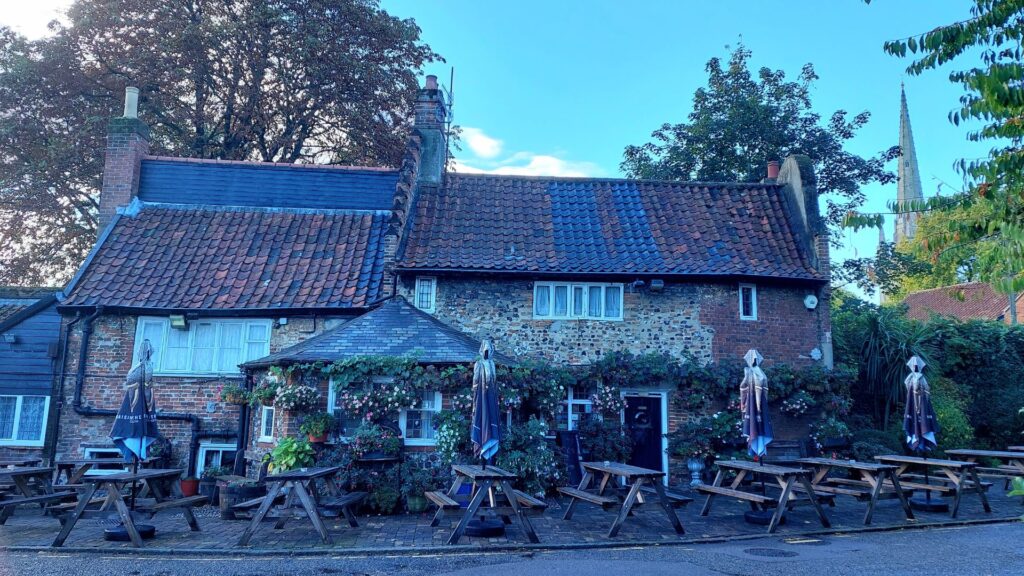
The pub, being so old, has seen centuries of Norwich history, the good and the bad, and many of those events have left a mark on the pub, if nothing else, in terms of the folklore and ghost stories. Lord Sheffield, a cavalry commander that came to Norwich in 1549 to crush Kett’s Rebellion, was de-horsed and brutally murdered with a cleaver while he surrendered nearby to the pub. Dying and bleeding, his men pulled him into the pub and barricaded themselves inside and he passed there. Supposedly his ghost, nicknamed Sam by the current owners, likes to make itself known to patrons and workers alike. James Blomefield Rush, a double murderer who shot his landlord and his landlord’s son in a dispute over money, supposedly planned the murders in the pub and his ghost is reportedly seen at a table inside. Possibly our favourite figure however is Elizabeth Howes, a woman who bucked the norms of the time by running the pub and orchestrating a very successful smuggling business alongside to provide the many pubs of the city with contraband liquor. She was never caught and is apparently sometimes seen behind the bar, watching over customers with a stern eye.
Today the pub is home to wonderful ancient low beams, a ceiling so low they had to lower the floor in the 1970s just to install a bar as the pub had been forced to sell ale from a barrel up until this point, and a fantastic range of beers, beverages and food. In summer, there’s a pleasant seating area outside where you can really take in the pub’s old exterior.
The Lollards Pit
If you’re a fan of the darker and more macabre side of history, then this is the pub for you. The Lollards Pit holds the distinction of being a site of mass execution, where religious persecution meets a cosy little pub! The “Lollards” were a group of people from the 15th-16th centuries who fundamentally disagreed with the church. They were followers of John Whycliffe, a theologian from Oxford University who had disagreed with the corruption and power he saw within the church. He believed Christianity should go back to scripture and have only “poor priests” with no vows and the money should be removed from the church to make it more humble. He also advocated to have the bible translated into early English rather than Latin to make it readable to the lay person (if they were literate) rather than keeping it in control of the clergy.
He was kicked out of Oxford due to his “extreme views” but died of natural causes, only for his followers to start gaining momentum in the early 1400s. The church put its foot down, dug up his remains from his grave and burned them at the stake as a symbol he was a heretic and throwing his ashes into the River Swift in Leicestershire. His followers were dubbed “Lollards,” a cruel middle dutch term that meant “to mutter or mumble” and was used to insult the lack of education in the lower classes. Once identified, they were then rounded up around the country, imprisoned, tortured and burned at the stake. In Norwich, the spot where the pub now stands was home at the time to a large chalk quarry, owned by the church as it was where the foundation material for the cathedral was mined. It was chosen as the spot for these burnings, mostly as it was outside of the walls. We know from records that at least three people were burned in 1428, half a dozen in the first half of the 1500s and up to 50 during the reign of Queen “Bloody” Mary as she fought through mass executions to bring England back under the Papacy. Local rumours will tell you that prisoners were held in the cellar of the pub but this has yet to be substantiated!
Like with other pubs, this one is supposedly haunted, but the horrors that unfolded where the pub now sits makes for a more compelling argument for possible angry spirits. Reports of screams and howls through the cellar, unexplained moving furniture and glasses and the spectre of a woman who bursts into flames in the bar before horrified onlookers make this pub a favourite for ghost hunters.
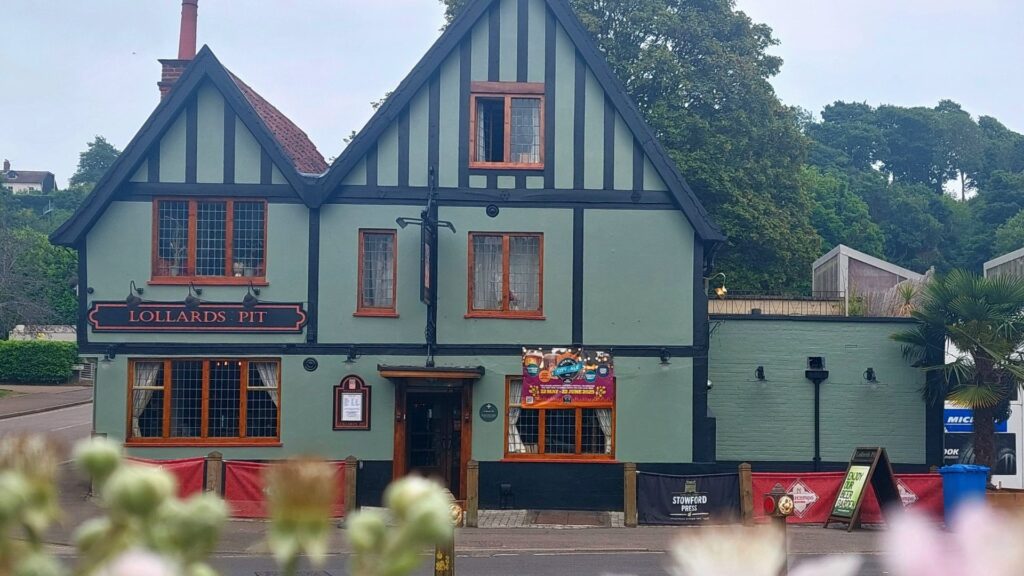
The pub itself is thought to be at least 17th century, possibly Tudor, and has been serving beer to the people since its construction. The interior is beautifully historic with a number of original wooden beams spiderweb through the building. Out the back of the pub is an original yard, complete with medieval well, that makes for a nice spot on warmer days to enjoy one of the many beverages served here. They also host quizzes, karaoke and regular events and are LGBTQ+ friendly. It’s definitely worth a visit, although the horrific events of times gone by on this site may linger at the back of your mind during your time there!
The Lamb Inn
Trying to pin down the age of The Lamb Inn is difficult. Some sources will tell you that the pub is from the 12th Century but that is certainly not the case when it comes to the physical building. It is most likely that it sits on the site of a previous medieval structure but the building itself cannot be any older than the 16th/17th century. The area the pub is situated in is very interesting (if not depressing) historically. When the first Jewish people arrived with William the Conqueror in 1066, they settled into the area to act as money lenders (a job that could not be held by the Christians due to their faith.) The Jewish Quarter persisted as a thriving community but sadly in 1290, King Edward I ordered all Jews to be expelled from England. This, as well as previous events (see William of Norwich) led to mass attacks on Jewish communities, massacres and their eventual expulsion until the 17th century. Sadly in 2004, a well was discovered during construction of Chapelfield Shopping Centre was found to hold the bodies of 17 Jewish people (6 adults and 11 children), who appeared to have been caught in the massacre of Jewish citizens in 1190 as part of antisemitism brewed up by crusaders.
The pub has been officially trading since 1574 and, we think, originally traded under the name The Holy Lamb. It’s seen many different landlords and landladies but the name that has become associated with the pub is that of John Aggus. John was murdered in the pub by his brother in law, Timothy Hardy in 1787. The motive is a matter of debate but it’s largely believed that Timothy (originally from Newton Flotman) was having a violent argument with his sister Susanna (John’s wife) and when John stepped in to intervene, Timothy stabbed him to death. Other sources suggest that Timothy had worked for John and an argument had ensued over the former’s conduct in the pub and that was what led to the murder. Regardless of why it happened, poor John still lost his life in that pub and his ghost (a tall, bearded but gentle and friendly man) is supposedly still seen smiling at customers. In 1939 the pub suffered a horrendous fire and a local story tells of how the then landlady’s grandson leapt from a 12 foot window into the street to find the fire services once he had seen the blaze!
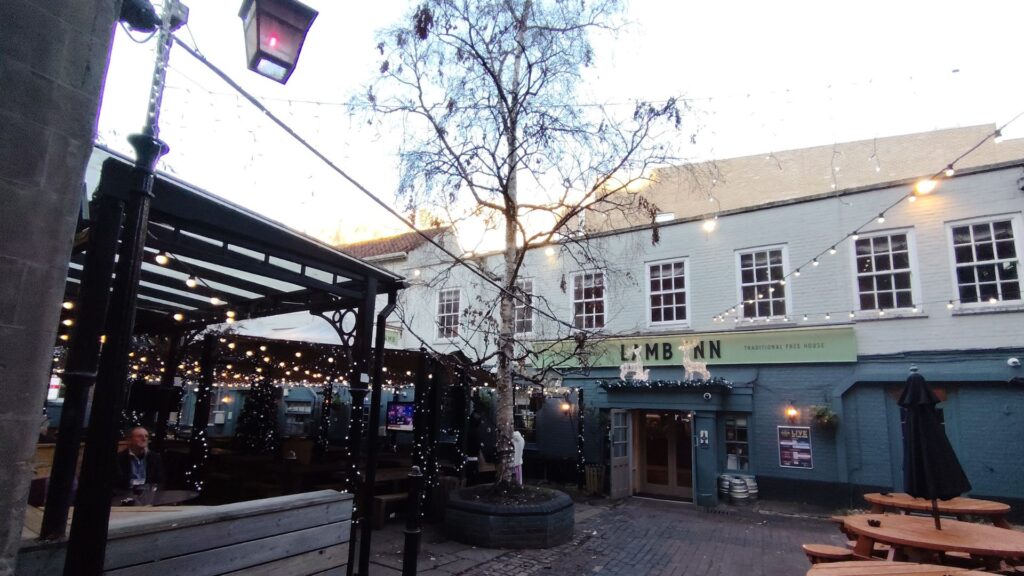
The pub itself sits in a beautiful courtyard, accessible from Orford Place, and is always welcoming and friendly. The courtyard includes coverings, warm lighting and heaters for winter and the pub serves food and an array of nice drinks!
The Murderers
With a name such as “The Murderers” you already know this pub is going to have a grisly history and it certainly does! Officially named both The Murderers and The Gardeners Arms the pub has been running since at least 1841 but the building dates back to 1696. It used to be two separate buildings with an alleyway running down the middle (where the front door now sits) but is now all one large building.
Local legend will tell that the pub got its name from the murder of a prostitute by a client but the actual story was uncovered by the current landlord Phil Cutter. In 1895, the landlady of the pub, Maria Wilby and her daughter Mildred co-ran the pub together after Mildred had left her husband, Frank Miles, an ex-cavalryman who had served in India, for his aggressive and abusive behaviour. Divorce was rare in the Victorian era and it was thought that Frank felt like his “honour had been impeded” by her decision. The two had been separated for some time, possibly months to a year, and it was said that Frank had become obsessed with Mildred, wanting her to come back to him. Mildred on the other hand had moved on with her life and was potentially courting a new man. Frank got wind of this and decided to head to the pub to confront her. Once there however, in an infantile fit of rage, he picked up a heavy brewing tool and beat her to death with it in the alleyway. He should have hanged for the crime but sadly he was a “popular man” and despite his disgusting actions, a petition with 16,000 signatures meant that his sentence was commuted to life imprisonment. Thankfully, however, karma prevailed and he died in his 10th year in prison (of what is largely believed to be syphilis!).
Soon after his death, the then owners of the pub wanted to change the name of the pub officially to The Murderers but the city denied it based on wanting to keep the pub’s heritage. Despite this the owners decided to create a pub sign that had each of the names on either side which is a theme that stuck until fairly recently. Landlord Phil has also made sure to preserve the memory of poor Mildred by displaying pages of documents from her life in the pub itself.
Today the pub is extremely popular and has a range of weekly events such as sport showings and live music and sells a variety of real ales and other drinks including their own ale! It is full of character and retains original timberwork and other elements. This one is definitely worth a visit if you find yourself in the Timberhill area of Norwich!
Travel – Public transport
Norwich isn’t a large city, but nonetheless, you might not want to or be able to walk from destination to destination. Luckily there are options when it comes to public transport! From late May to late September, there is the “hop-on, hop-off” Open top sightseeing bus that goes around most of the historic sites, allowing you easy access for a low price. Outside of this season though, there are many different bus routes laid out by First and Sanders bus companies throughout the city and to the surrounding areas including coastal towns and historic villages. A train service through East Anglia will also take you to some destinations in a fraction of the time. Taxis are also readily available at reasonable prices and Veezu, Enterprise and Courtesy are some of the more prominent companies. Black cabs are available from the train station as well.
So, if you have friends and family coming to stay this festive season, or just fancy treating yourself to a holiday at home, Norwich has something for you! Enjoy!
Sources
Cultura Obscura Things To Do In Norwich
Invisible Works Rosary Cemetery
Visit Norwich Norwich Cathedral
Norwich Society Cathedral Precinct
Norfolks Best History of the Lanes
Historic Churches St Gregory’s
Joe Mason Historic Shops
History of Norfolk Adam and Eve
Norwich Haunted History Lamb Inn
Norwich Pubs and Breweries Past and Present – Frances and Michael Holmes